
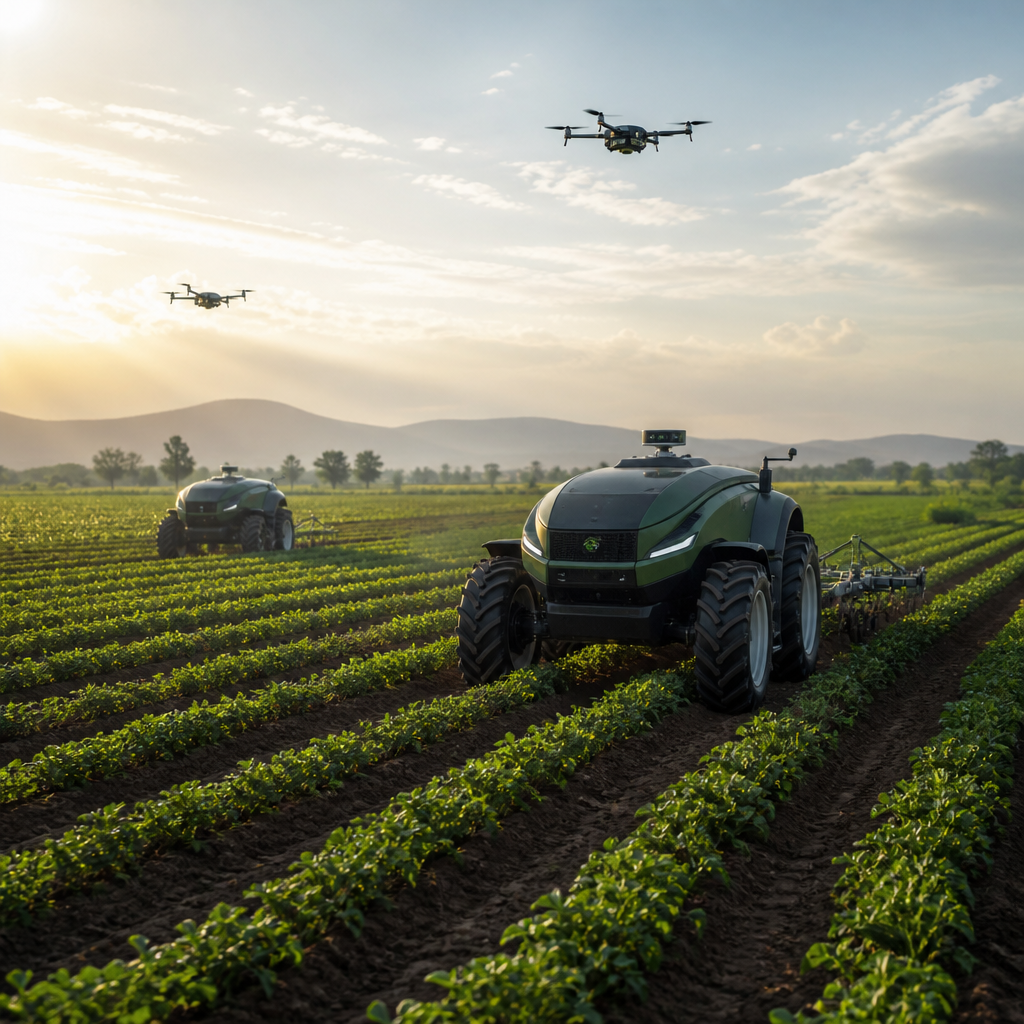
Agriculture is undergoing one of the most significant transformations in its history. From the fields where crops are grown to the supply chains that move equipment across continents, every layer of the industry is being reimagined. Autonomous machinery, precision farming technology, and smarter distribution networks are converging to create a new era of productivity — one that demands both innovation on the ground and strategic thinking at the business level. Understanding how these forces interact is essential for farmers, dealers, and agribusiness leaders who want to stay competitive in a rapidly evolving landscape.
The Rise of Autonomous Machinery in Farming
For decades, the tractor was the backbone of agricultural productivity — a machine operated by skilled hands, guided by experience and intuition. Today, that same machine is being equipped with GPS systems, computer vision, and artificial intelligence that allow it to operate with minimal human intervention. Autonomous tractors are no longer a distant concept; they are working in fields across North America, Europe, and beyond, planting, tilling, and harvesting with a level of consistency that human operators simply cannot match over long shifts.
The advantages are substantial. Autonomous systems can work around the clock, reducing the dependency on seasonal labor — a persistent challenge for agricultural operations of all sizes. They apply inputs like fertilizer and pesticides with pinpoint accuracy, reducing waste and environmental impact. And because they generate continuous streams of operational data, they allow farm managers to make better decisions based on real performance metrics rather than estimates. According to John Deere’s overview of the key benefits of autonomous tractors, these machines improve efficiency, reduce operator fatigue, and enable more precise field operations — all of which translate directly into better yields and lower costs.
Overcoming the Adoption Curve
Despite the clear advantages, adoption of autonomous technology in agriculture has not been uniform. Smaller operations often cite cost as the primary barrier, while others point to a lack of technical support infrastructure in rural areas. There is also a cultural dimension — farming is a tradition-rich industry, and many operators are understandably cautious about handing control of expensive equipment to algorithms. Bridging this gap requires not just better technology, but better education, demonstration programs, and trusted dealer relationships that help farmers understand what these systems can realistically deliver on their specific land and crop types.
Equipment Dealers as Trusted Partners in Agricultural Innovation
The role of the agricultural equipment dealer has evolved considerably. In the past, a dealer’s primary function was to sell and service machinery. Today, the best dealers function as strategic partners — helping farmers navigate technology choices, financing options, trade-in decisions, and long-term equipment planning. This shift is particularly important as the complexity of modern farm equipment increases. A tractor equipped with autonomous systems, telematics, and precision agriculture software requires a different kind of support than a conventional machine.
H&R Agri-Power exemplifies this evolved dealer model. With multiple locations across the mid-South and a deep commitment to serving both large-scale commercial operations and family farms, the company has built a reputation for pairing high-quality equipment with the kind of knowledgeable, responsive service that modern agriculture demands. Their approach reflects a broader truth about the industry: technology alone does not transform farming — it takes people who understand both the machines and the land to make that transformation meaningful.
Service Infrastructure Matters as Much as the Equipment Itself
One of the most overlooked aspects of agricultural equipment investment is the importance of service availability. A breakdown during planting or harvest season can cost a farming operation far more than the price of the equipment itself. This is why proximity to qualified technicians, access to genuine parts, and rapid response times are not just conveniences — they are critical business considerations. Dealers who invest in their service departments and maintain strong manufacturer relationships are the ones who earn long-term loyalty from their customers.
Global Distribution and Market Expansion in the Agri-Equipment Sector
While autonomous technology is reshaping what happens in the field, equally significant changes are occurring in how agricultural products and equipment reach global markets. The agribusiness supply chain has become increasingly international, with manufacturers sourcing components globally and dealers serving customers across wider geographic footprints. For companies looking to expand their reach, understanding how to navigate international distribution channels is a strategic imperative.
This is a challenge that extends well beyond agriculture. Businesses across industries are grappling with the complexity of entering new markets — managing regulatory requirements, building local relationships, and establishing brand credibility in unfamiliar territories. Insights from sectors with deep experience in international expansion can offer valuable lessons. For example, how Trulife Distribution approaches global market entry illustrates the kind of structured, relationship-driven strategy that helps companies scale internationally without losing the quality and consistency that define their brand at home.
Applying Distribution Intelligence to Agricultural Markets
For agricultural equipment manufacturers and dealers, the lessons of smart international distribution are directly applicable. As demand for precision farming technology grows in emerging markets across Asia, Africa, and Latin America, companies that have built strong domestic distribution networks will be best positioned to extend their reach. The key is replicating not just the product offering, but the service culture and customer relationships that make those networks successful in the first place. Expansion without infrastructure is a recipe for reputational damage — a lesson that applies equally whether you are selling tractors or consumer goods.
The Intersection of Technology, Trust, and Long-Term Value
What ties together the trends of autonomous machinery, dealer evolution, and global distribution is a common thread: the importance of trust. Farmers trust their equipment dealers to guide them toward the right investments. Dealers trust their manufacturers to deliver reliable products and strong support. And manufacturers trust their distribution partners to represent their brand with integrity in every market they enter. When that chain of trust is intact, the entire system functions more efficiently — and the farmer in the field ultimately benefits.
As autonomous technology matures and becomes more accessible, the competitive advantage will increasingly belong to those who combine technological capability with deep customer relationships. The farms that thrive will be those that embrace innovation without abandoning the practical wisdom that has always defined good agriculture. And the businesses that serve those farms — dealers, distributors, and manufacturers alike — will succeed by staying genuinely connected to the needs of the people they serve.
Conclusion: A Smarter Future for Agriculture
Modern agriculture stands at a crossroads where technology, business strategy, and human expertise must work in concert. Autonomous tractors are delivering measurable gains in efficiency and precision. Smart dealers are helping farmers navigate an increasingly complex equipment landscape. And forward-thinking distribution strategies are opening new markets for agricultural innovation around the world. The future of farming will be shaped by those who understand that progress is not just about the machines — it is about the relationships, the knowledge, and the commitment to service that make those machines truly valuable in the hands of the people who feed the world.
